
Global funds have pumped in over Rs 38,000 crore (about $5.5 billion) into domestic equities since February 20, helping the Sensex rebound 2,671 points, or 7.6 per cent, from its 2019 low.

Forex dealers said besides the dollar's gains against the euro overseas, increased demand from importers for the US currency and a lower opening in the domestic equity market also put pressure on the rupee.

We have millions of newbie investors who are clueless about how to handle sudden and severe adverse market reactions, which arrive from time to time, observes Debashis Basu.
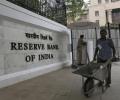
While RBI's foreign exchange reserves have swelled to over $400 billion, it has a 'sell' position of $981 billion.

'Thankfully, most investors in India have now seen through this false narrative and are once again deploying their hard-earned money.

'The good news is that money continues to flow into India-focussed offshore funds.'

The Securities and Exchange Board of India (Sebi) may allow non-resident Indians (NRIs) and Overseas Citizens of India (OCIs) greater exposure to domestic equities if their investments are sent through foreign portfolio investors (FPIs) registered at the GIFT City International Financial Services Centre (IFSC). The proposal will be taken during Sebi's board meeting on Saturday along with other key agenda items such as easing of voluntary delisting mechanism and introduction of a regulatory framework for real estate fractional ownership platforms, said people in the know. At present, the combined holdings of NRIs and OCIs in a global fund have to be less than 50 per cent, while that of a single NRI or OCI is capped at 25 per cent.

China approved 9,582 new foreign-funded companies in first 5 months.

Announcement of macroeconmic data such as industrial production and inflation, the US Federal Reserve's interest rate decision along with trends in global equities would dictate movement in the stock market this week, analysts said. Besides, foreign fund trading activity would also guide the trends in equities. "All eyes are now on the US Fed policy outcome for cues, which is scheduled on June 14. In the following sessions, the European Central Bank (ECB) and Bank of Japan (BoJ) will also announce their policy decisions.

Smaller stocks have emerged as Dalal Street's favourites in 2023 that has turned out to be a "great year" for equities, rewarding investors with big gains, driven by optimism over the country's macroeconomic fundamentals and heavy retail investors participation. Experts said equity markets are experiencing a prolonged bull run and it is during this time that the midcap and smallcap segments tend to outshine their larger counterparts. Till December 22 this year, the BSE smallcap gauge has jumped 13,074.96 points or 45.20 per cent while the midcap index has surged 10,568.18 points or 41.74 per cent.

Foreign institutional investors (FIIs) are set to pump in more funds in debt securities, as the next government under the Bharatiya Janata Party (BJP) is expected to be a stable one and is seen as growth-oriented by market participants.

'As much as $4 billion in India's start-up companies has come from Chinese funds.' 'Government policy must not remain indifferent to the problems India's start-up ventures are likely to face after the change in FDI rules,' says A K Bhattacharya.

FPIs have turned net sellers in 2022 after being net buyers in the last three years.

Senior Congress leader Jairam Ramesh also asked the RBI to make public details of FDI inflows from Cayman islands since demonetisation.

What stood out in his 15-year journey as a member of the political executive at the Centre was his glowing record as India's most successful and effective finance minister. Both as prime minister and finance minister, he understood the importance of gradualism, except when the economy or the polity was in a crisis.

The ministry seeks to make lending requirements flexible for banks financing key stalled projects.

This flight of capital began in early August due to risk-aversion created first by rising geopolitical tensions due to North Korean aggression and second by the US Fed's decision to shrink its balance sheet

The domestic currency had lost 63 paise to close at over four-month low of 61.18 against the dollar in Friday's trade on weakness in global stock markets and a strong US currency overseas.

'For those looking at forward-looking signals for the economy from the stock markets, the relative performance of small and mid-caps may be a better indicator of the future than the index levels of the narrower and more popular indices', says Neelkanth Mishra.

The government will press ahead with the sale of public sector companies that have been approved by the Cabinet, Finance Minister Nirmala Sitharaman said on Thursday. Highlighting that FDI flow into India is much higher compared to other emerging economies, she said India's strong macroeconomic fundamentals, ability to do reforms and a stable government help attract long-term foreign funds into Indian businesses.

With no major domestic market-moving event scheduled this week, stock market investors would largely focus on global trends and foreign fund movement, and may face volatility amid monthly derivatives expiry, analysts said. This week Federal Open Market Committee (FOMC) meeting minutes are due for release which would provide further cues to the market, Siddhartha Khemka, Head - Retail Research, Motilal Oswal Financial Services Ltd, said. "With all major events behind us, participants will take cues from global markets, crude and currency market movement.

The rupee closed at 60.31/32 on Thursday.

'Historically, the markets tend to perform well during election years as governments aim to increase spending and call attention to growth.'

The policymaker said the RBI had not reached the point where specific actions were under consideration.

'Rationalising TDS on dividends for FPIs to reduce it to treaty rates ranging from 5 to 15 per cent, depending on the country of residence of FPIs from current rate of 20 per cent will provide a big cash flow relief for FPIs.'

Traders are looking ahead at the consumer prices data due on Wednesday, amid rising expectation the Reserve Bank of India could opt for earlier-than-expected cuts in interest rates should inflation continue to ease.
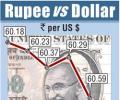
Dealers attributed the fall in the rupee on Tuesday to dollar's gains against other currencies overseas, but a higher opening in the domestic equity market capped the fall.

Foreign Direct Investment into India rose by 13 per cent in 2020, boosted by interest in the digital sector, and while fund flows "declined most strongly" in major economies such as the UK, the US and Russia due to the Covid-19 pandemic, India and China "bucked the trend", the UN has said.

Standard and Poor's raised the outlook for India's "BBB-minus" rating back to "stable" from 'negative,' saying Prime Minister Narendra Modi government's 'strong' mandate would allow it to implement fiscal and economic reforms.

n New York market, the dollar posted second-quarter losses against nearly all major rivals yesterday, with the exception of the euro.

After the latest rout, the American depositary receipt (ADR) premium of HDFC Bank to its local shares has shrunk to nearly zero. Shares of HDFC Bank on Thursday fell 3.1 per cent to Rs 1,490, extending its two-day decline to 11 per cent. Meanwhile, the ADR has slumped over 15 per cent in the past two trading sessions.

To increase fund flow in the bond market, market regulator Sebi on Wednesday issued guidelines allowing overseas individual investors to invest up to $1 billion in corporate bonds and debt schemes of mutual funds without any lock-in period.

Equity market will be guided by global trends, macroeconomic data announcement and foreign fund movement in a holiday-shortened week ahead, analysts said. Movement of the rupee and Brent crude oil will also remain in focus this week, they added. "The bulls need some support from global markets to continue Friday's momentum.

'Higher valuation remains the only spoiler for equities.'

tailwinds of a remarkable year and handsome investor returns, Indian equities are set for an eventful journey in 2024, with a slew of local and global cues -- varying from interest rates to Lok Sabha polls to geopolitical happenings. Analysts are of the view that the bull run in the domestic equity market will continue, and over the next 3-6 months, the benchmark indices -- Sensex and Nifty -- could climb up to 7 per cent. In 2023, the 30-share BSE Sensex jumped 11,399.52 points or 18.73 per cent, and the NSE Nifty climbed 3,626.1 points or 20 per cent.

Most dealers said the heavy buying by state-run banks was on behalf of the central bank, looking to limit the volatility in the rupee, in the face of foreign fund flows into the share market.

Sebi also allowed foreign investors to own up to 15 per cent stake in domestic stock and commodity exchanges

India's mutual fund (MF) industry had barely any retail footprint when it completed 50 years in 2013. MFs had Rs 7 trillion in assets under management (AUM) in March 2013, of which around Rs 5 trillion was in institution-focused debt funds. By comparison, bank deposits in the country stood at Rs 67.5 trillion around the same time.

The BSE Midcap and the Small-cap Index have run up 25.3 per cent and 31.3 per cent respectively over the past year. Valuations are no longer cheap, notes Sanjay Kumar Singh.

India's inclusion in JP Morgan's bond index can channel billions of dollars into India. How will the government securities market handle it?
